How to Choose Custom Food Wrapping Paper
The right custom food wrapping paper should do more than carry your logo. It needs to suit the food you serve, fold neatly around your portions, and work smoothly during a busy shift. Start with your menu and service conditions, then choose the material, sheet size, and print layout.
For restaurants, cafés, bakeries, delis, and food trucks, Custom Food Paper can support a consistent presentation across wraps, trays, and baskets. This guide explains what to compare before requesting a quote, so your paper choice supports both presentation and practical handling.
Start with the food and how you serve it
Build your requirements around actual menu items. A dry cookie, a greasy breakfast sandwich, and a cold deli sandwich present different wrapping challenges. Describe those differences when discussing paper options instead of asking for a material by name alone.
- Grease: Note whether oil or butter reaches the paper during normal service.
- Moisture: Consider sauces, fresh vegetables, condensation, and steam.
- Temperature: Identify whether food touches the paper cold, warm, or hot.
- Contact time: Distinguish immediate dine-in service from takeout or delivery.
- Packaging role: Specify whether the sheet wraps food completely, separates items, or lines another container.
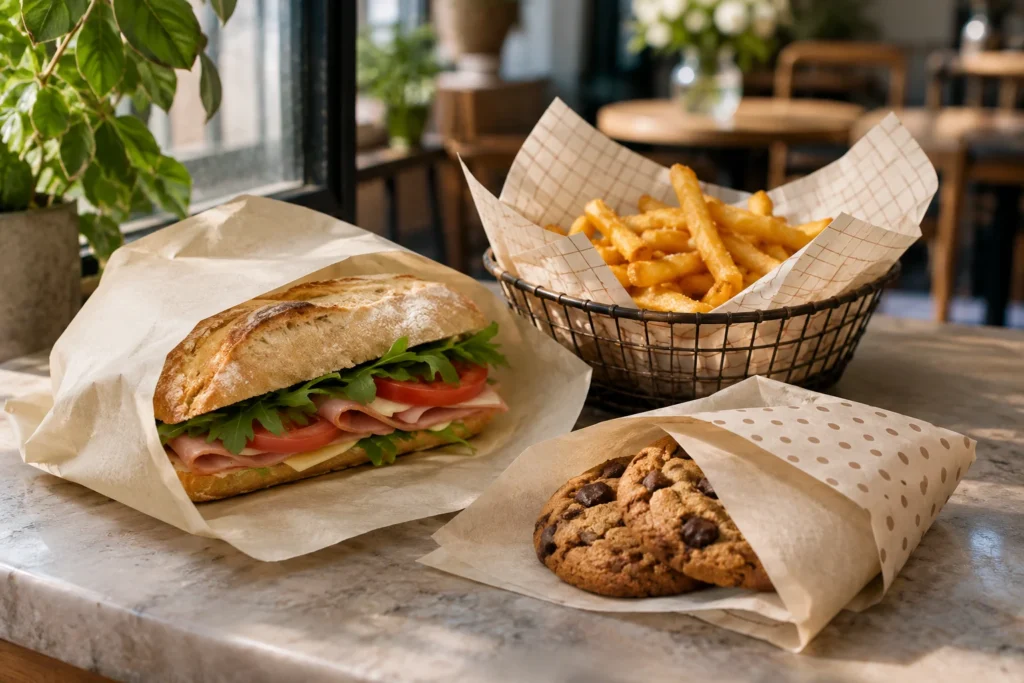
For example, a basket liner does not need to fold around a sandwich, but it should fit the basket and handle the food placed on it. A sandwich wrap needs enough coverage for a secure fold without excessive bulk.
Compare paper materials by their intended use
Material names are a starting point. Coatings, treatments, and construction can change performance, so confirm the suitability of the specific paper for your food and service conditions.
Wax paper and deli paper
Wax paper and deli paper are options to discuss for sandwich wrapping, food handling, and liners. Explain the amount of grease and moisture involved. Do not assume every deli paper has the same coating or barrier performance, or that wax paper is suitable for oven use.
Greaseproof paper and parchment
For oily foods and buttery baked goods, ask about greaseproof paper. If the paper will enter an oven, discuss parchment intended for that purpose and confirm its temperature and use limits. A printed serving liner should never be treated as baking paper without checking its suitability.
Butcher, freezer, glassine, and kraft paper
These options serve different needs. Describe whether you need a meat wrap, freezer storage wrap, bakery presentation sheet, or outer wrap. Do not select kraft paper solely for its appearance or assume glassine provides the moisture protection your product requires. Ask about the exact construction and intended application.
When comparing Custom Printed Papers, keep your food requirements beside your design preferences. A useful shortlist identifies both the material and its job, such as a liner for fries or a wrap for a cold sandwich.
Choose sheet sizes around real portions
Measure your largest regular portion, including fillings and toppings. For wraps, allow enough paper for overlap and folded ends. For liners, measure the inside of the tray or basket and decide how much paper should extend beyond its edges.
Use an unprinted sheet cut to your proposed dimensions to check the fit. Have someone wrap a typical order at normal working speed. This can reveal awkward folds, unnecessary excess, or exposed food before you finalize a sheet size.
- List the menu items that will use the paper.
- Group items with similar dimensions and wrapping needs.
- Try a proposed size with each group.
- Choose separate sizes only where they improve handling or coverage.
One size may simplify stocking, but forcing every item into the same sheet can create waste or slow assembly. Balance inventory simplicity against portion fit.
Design a print that works after folding
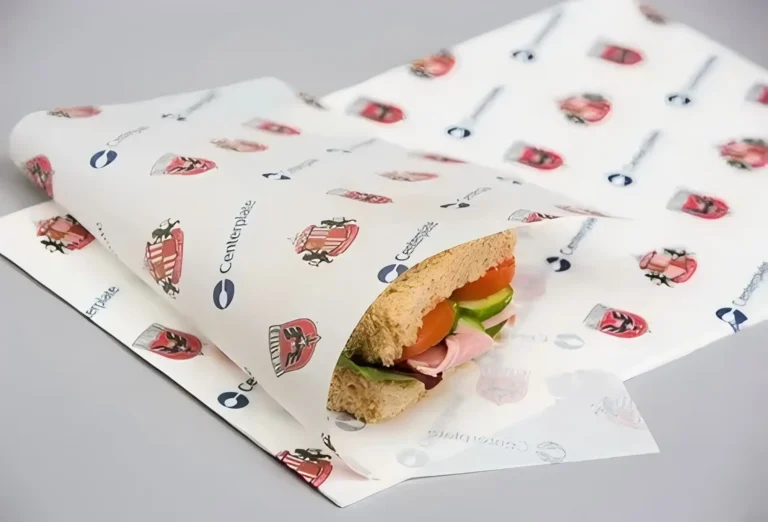
Your artwork needs to look good on a finished order, not just on a flat sheet. A repeating logo pattern can keep branding visible across different folds. A large centered design may suit an open liner, but it can disappear beneath food or land along a crease.
Keep small details and fine lettering easy to read. Consider whether a simple pattern would work across your menu and packaging formats. If you use Custom Wrapping Papers for several products, check the layout against each wrapping method.
Review the digital proof for logo accuracy, spelling, artwork scale, spacing, and orientation. Confirm the sheet dimensions and material separately. A digital proof helps you review artwork; it does not show how the paper will handle grease, moisture, or heat.
Check food-contact suitability and disposal guidance
Tell your supplier whether the printed paper will touch food directly and explain the intended conditions. Ask for guidance on the complete paper construction, including coatings and printing. Food-safe inks are one part of choosing packaging appropriate for its intended use.
If environmental considerations matter to your business, ask about the specific material rather than relying on its color or texture. Coatings, food residue, and local collection rules can affect disposal options. Confirm local requirements before adding recycling or composting instructions to customer-facing packaging.
Plan your order around usage and timing
Estimate sheet usage from your own sales records, including peak days and seasonal changes. Count sheets per order rather than assuming every transaction uses one. Keep storage space in mind, and protect unused paper from spills, grease, and moisture.
Printed Wax Papers offers paper orders starting from 1,000 sheets, food-safe inks, and a free digital proof. Production takes 7–10 business days after the proof, with free USA shipping taking 3–5 business days. Allow time to review artwork and confirm order details before your required arrival date.
Frequently asked questions
Which custom food wrapping paper should I choose for greasy food?
Start by discussing greaseproof paper and other options suitable for your menu. Specify the food temperature, oil level, and expected contact time. Confirm the performance of the particular paper before ordering.
Can I use one sheet size for my whole menu?
Possibly. Try the proposed size with your smallest and largest items. If it causes bulky folds or incomplete coverage, separate sizes may make service easier.
What should I include in a quote request?
Include your food type, wrapping or lining application, sheet dimensions, quantity, artwork, and required delivery date. Mention heat, moisture, or grease exposure so the material discussion starts with your actual needs.
Request paper that fits your menu
Bring your food requirements, preferred dimensions, and logo to Printed Wax Papers. Request a free quote for custom food wrapping paper and a free digital proof to review your design before production.