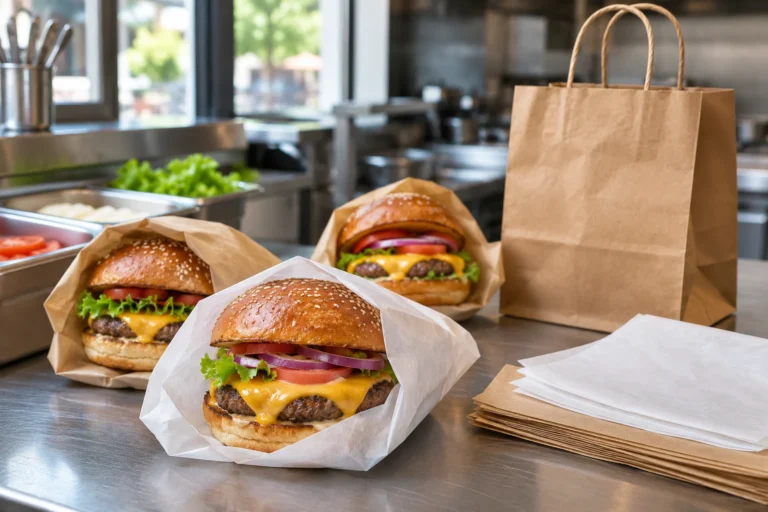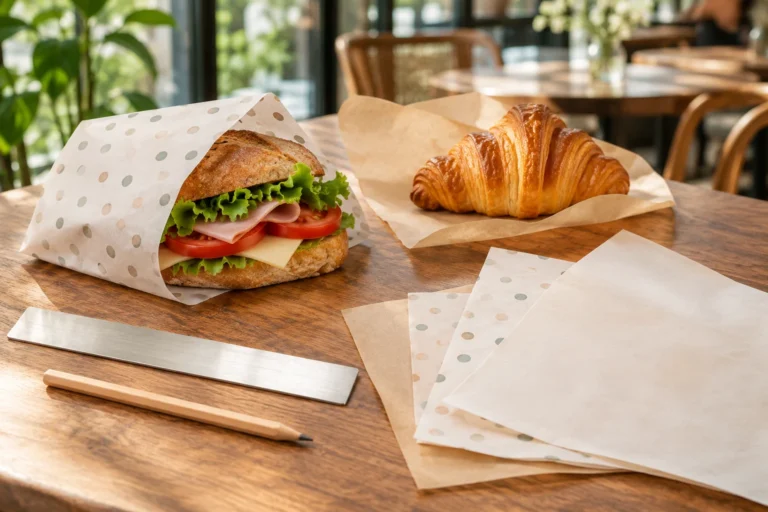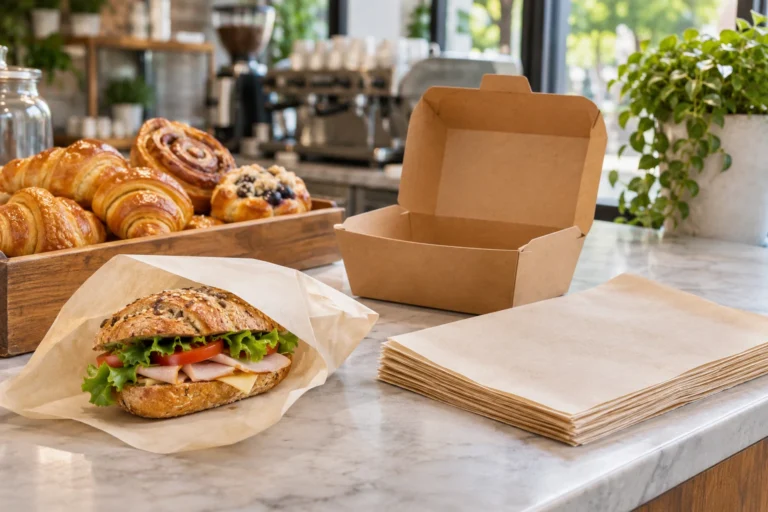
How to Size Paper Wraps for Sliders and Double Burgers
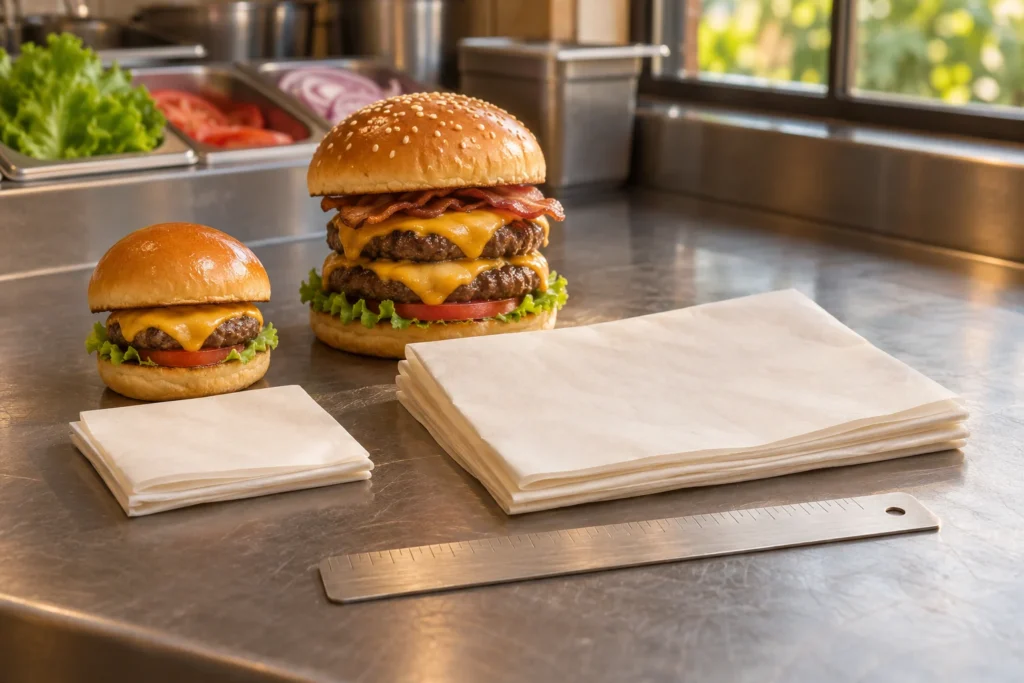
The right burger wrapping paper sizes depend on more than bun diameter. A low slider and a tall double burger need different amounts of paper, even when their buns look similar. Start with the finished sandwich, then allow enough material for side folds and a secure seam.
Before ordering Custom Burger Paper, test a few sheet dimensions with your actual menu items. A useful wrap should cover the burger without crushing the bun, hold its folds during handling, and open easily for the customer.
Measure the burger as you serve it
Measure a fully assembled burger with its usual cheese, vegetables, sauces, and toppings. An empty bun gives you a starting point, but it does not show how much paper a finished order needs.
Record three dimensions in inches: width across the bun, depth from front to back, and total height. For a round burger, width and depth will be similar. Check the widest toppings, too, especially lettuce or patties extending beyond the bread.
- Slider: Measure one complete slider, including any pick that will remain during wrapping.
- Double burger: Measure the assembled stack without pressing it down.
- Loaded variation: Test the tallest standard build, including optional toppings customers commonly add.
- Service setup: Note whether the burger goes into a basket, box, or takeout bag.
Use these measurements to compare trial sheets. Keep any sharp pick from puncturing the paper, and decide whether it should be removed before wrapping.
Starting paper sizes for sliders and double burgers
The dimensions below are trial sizes, not guaranteed fits or a statement of available product dimensions. Paper flexibility, burger shape, and folding method can change the result. Confirm your selected dimensions before placing an order.
Small sliders: try an 8 × 8-inch sheet
For a slider around 2½ to 3 inches wide with a modest filling, an 8 × 8-inch square is a practical first mockup. Place the slider diagonally on the sheet so the corners give you room to fold around the sides.
If the folds barely meet, test a 9 × 9-inch sheet. If excess paper creates a thick lump under the slider, try a smaller mockup or adjust placement before changing the order size.
Tall sliders: compare 9 × 9 and 10 × 10 inches
A slider with two patties, thick toppings, or a domed bun may need more coverage than its diameter suggests. Compare these two sizes using the same fold. Choose the smaller sheet only if it closes comfortably without compressing the sandwich.
Double burgers: compare 12 × 12 and 14 × 14 inches
For a double burger roughly 4 to 5 inches wide, a 12 × 12-inch sheet is a useful starting test. A tall stack or wide toppings may need a 14 × 14-inch mockup. Extra height uses paper that would otherwise form the closing overlap.
Do not automatically choose the largest sheet. Too much paper can slow wrapping, create bulky folds, and make the burger awkward to hold. The goal is enough coverage with manageable folds.
Match the sheet to your wrapping method
Full wrap for takeout
A full wrap needs enough paper to cover the top, fold both sides inward, and finish with an overlapping seam underneath. Test the closure while holding the burger naturally. If you must squeeze the bun to make the edges meet, increase the sheet size.
As a practical trial target, aim for about 1 to 2 inches of overlap at the main seam. This is a folding allowance, not a universal rule; confirm that it stays tucked during your normal handling.
Half wrap for immediate eating
A half wrap leaves the top exposed while covering the lower portion and providing a handhold. It may use less paper than a full enclosure, but still needs adequate side coverage to manage sauce and loose toppings.
Test it with someone lifting the burger from the basket. If the paper slips away or the bottom opens, adjust the fold or increase the sheet dimensions.
Basket liner with a loose fold
A sheet used mainly as a basket liner should fit the basket as well as the burger. Decide whether staff will fold it around the sandwich or leave it open. Custom Deli Paper may also be worth considering for this service style, depending on the intended use.
Choose paper performance alongside dimensions
A larger sheet cannot compensate for paper unsuited to the food. Consider grease resistance, moisture, flexibility, and how the sheet behaves against a hot burger. Ask about suitability for your intended food contact, temperature, and holding conditions.
When reviewing Custom Printed Papers, compare the paper type as well as the format. Wax, greaseproof, parchment, and other papers have different uses; do not assume they are interchangeable or suitable for reheating equipment.
For sustainability decisions, check the finished material and local disposal options. Food residue, coatings, and local collection rules can affect whether used wraps belong in recycling, composting, or trash.
Run a realistic wrapping test before ordering
- Prepare two candidate sizes. Use food-contact-suitable trial sheets for testing with food. Keep ordinary craft-paper mockups separate from food.
- Wrap the same burger build. Keep toppings and placement consistent so the comparison is useful.
- Check the folds. Look for exposed corners, stretched paper, bulky seams, and crushed buns.
- Pack the order. Place it in the actual basket, box, or bag used during service.
- Wait your usual holding time. Check grease transfer, dampness, seam movement, and ease of opening.
- Record the result. Note sheet dimensions, paper type, burger build, and folding steps.
Have more than one staff member repeat the test. A size that works consistently across the team is more useful than one that requires a precise fold from a single experienced employee.
Frequently asked questions
Can one paper size work for sliders and double burgers?
Possibly, but test both. A sheet large enough for a double burger may leave excessive folds around a slider. Separate sizes can make sense when the finished sandwiches differ substantially.
Should I measure the bun or the entire burger?
Measure the entire assembled burger. Bun width matters, but stack height and toppings determine how much paper remains for side folds and seam overlap.
Does a bigger sheet prevent grease leaks?
Extra coverage can help contain loose toppings, but grease performance also depends on the paper and holding conditions. Test the material with your actual burger, sauces, and service time.
Request a quote for your tested wrap size
Share your preferred dimensions, paper type, quantity, and logo with Printed Wax Papers. Paper orders start at 1,000 sheets, with food-safe inks, a free digital proof, and production in 7–10 business days after the proof. Free USA shipping takes 3–5 business days. Request a free quote for your slider or double-burger wraps.